Tuesday, October 25, 2011

The All Mighty Sound Bite

Last week I moderated a panel discussion featuring a set of accomplished corporate and government marketers.  Produced by market research firm Market Connections in partnership with Strategic Communications Group (Strategic), the topic was timely and telling:  social media adoption and use cases in the public sector.


My partner Chris Parente published an excellent write-up of the event here, as did Aol Government’s editor Wyatt Kash whose article can be found here.

The feedback I’ve received from attendees – including Strategic clients at Iron Bow Technologies, Blue Coat Systems, Pitney Bowes Government Solutions, Polycom and Intelsat General – has been mostly positive.  The exception has been a few shots at a rather rambling, nonsensical question blurted out by someone in the audience.

I’ve gotten a number of “what was up with that person” comments.  And deservedly so.  The inability to articulate a clear and concise message in an engaging manner is a shortcoming of many an executive.

It was with this experience in mind that I stepped into an event on Friday morning hosted by the Association for Corporate Growth,National Capital Chapter, as well a session today presented by the law firm Morrison Foerster and accountancy Ernst & Young.

Rather than transcribing my notes, I thought I’d share with you a few sound bites from each event that I thought hit the mark in terms of content and delivery.


“We are burdened by a distorted labor market.  There are a few number of highly qualified, technical talent who hold security clearances.  This creates high demand for those people that the customer ultimately pays for.”

Hillen's not stacking midgets.
“We are not in the ‘stacking midgets’ business when it comes to acquisitions.  We are looking for deals that position the company to win big jobs as a prime contractor.”

John Hillen
President and CEO
Sotera Defense Solutions


“If management uses the word ‘strategic’ in the press release announcing the acquisition, then short the stock.  It means they overpaid.”

Edward Caso, Jr.
Managing Director and Senior Analyst
Wells Fargo Securities
Caso dreads the word "strategic"


“The threat environment today is much more complex and multi-faceted.  The tools to combat these threats are diverse which creates market opportunities for integrators and technology companies.”

Greg Van Beuren
Managing Director & Partner
Bluestone Capital Partners


“We are in the business of prospecting for executives.  The best management teams will capitalize on market opportunities.”

Craig Bondy
Principal
GTCR


“The best dollar we spend at SAIC is the dollar we spend internally.  It delivers more value to the shareholder.”

Walter Havenstein
CEO
SAIC
SAIC's Havenstein

Sunday, October 16, 2011

2 Must Follow Approaches to Social Media Creativity

As the legions of the socially engaged continue to swell, the chatter from updates, likes, check-ins and tweets has reached a near deafening roar.


The same goes for the blogosphere where it has now become Mission Impossible-esq to stand apart from the army of scribes who pass much of their day furiously pounding away on a keyboard.  Their march for mindshare and SEO relevance is often one of content quantity, rather than a commitment to carefully constructed, insightful prose.  

The path to awareness we followed in our client work a mere 18 months ago was to stand up a social site, articulate an opinion, promote in targeted communities and lean on the company brand for credibility.  Those days have faded to reveal today's more challenging reality. 

For corporate funded social media marketing campaigns, the escalating competition for readership, attention and community places an absolute priority on creativity and thought leadership.  We've been quick to recognize that success attracting quantity and quality of social site visitors for our clients now demands the articulation of thoughts, opinions, perspective and analysis in a unique and, at times, unexpected way.

Consider the "Secure Thinking" program we work on in partnership with British Telecom's (BT) Managed Security Services group.  Now in its fourth year of execution, the clean, news publication inspired design on the social site remains constant.

Yet, the editorial strategy has evolved to incorporate user attributed content from clients, partners and industry analysts, collections of posts tuned to timely issues, and point/counterpoint themed debates that involve recognized and respected industry thought leaders.

Xtranormal videos included on Secure Thinking.
The program's priorities are clear: 

--deliver to readers an informed perspective they will only find on BT's Secure Thinking
--work collaboratively with the client's sales team to support the achievement of critical benchmarks related to lead generation, prospect cultivation and deal capture

Creativity is social media execution can also be expressed in how content is presented, rather than merely an innovative methodology for its construction. 

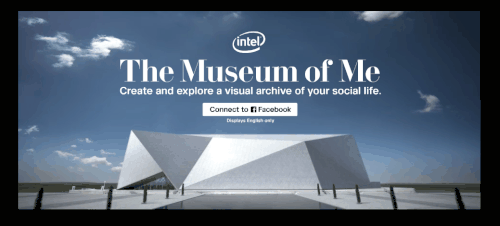
Case in point...I recently came across a Q&A with Intel'sPam Didner in Chief Content Officer magazine.  When asked about the "cool stuff" the company is working on in the area of social media, Didner cited a campaign developed by their Asia-Pacific team called "The Museum of Me."

Museum of Me shines with creativity.
The campaign's content is merely a repurposing of updates, photos and videos from a participant's Facebook presence.  However, the idea of displaying this content in a unique, museum style online environment is brilliant.

The audience reaction was swift and effusive with nearly one million hits within five days from launch.  Plus, the creativity and imagination of the campaign reflects well on Intel, positioning the company as a market leader with the ability to transform industries.

Sunday, October 2, 2011

Social Media and Sales Acceleration in the Public Sector

When it comes to the public sector there is seldom a quick hit in enterprise sales.


Prospective government customers are appropriately demanding.  They assess corporate capabilities and reputation.  They evaluate product features and service offerings.  They judge track record and contract performance. 

A vendor that attempts to rush this evaluation process can sour the deal and, in some instances, soil the long-term relationship.  That's because connections with government buyers are cultivated over time. 

In fact, it's quite common for the opportunity identification and capture process to be measured in years.

The payoff sure is sweet though.  Revenue generated from a multi-year, enterprise deal with a government agency can run well into the millions of dollars.  Plus, the lifetime value of the customer engagement is significant, as it provides a critical qualification that can lead to follow-on work and new opportunities.

At Strategic Communications Group (Strategic), the majority of our clients sell complex products and services to government agencies, at both the federal and state/local levels.  As such, our social media marketing focus and engagement methodology has gravitated towards direct support of the three most important benchmarks for success in the sales process -- lead generation, cultivation of prospect relationships and deal capture.

Yes...it is possible for executive management and marketers to align social media with sales by following these four steps:

Step 1 Evaluate prospects in the pipeline and prioritize the hot ones.  Work closely with the sales team to cull prospects based on their purchase authority, intimacy of the existing relationship and timeline to buy.  We'll typically select 20 to 25 targets who we anticipate having a need in the next 18 months.

Step 2 Map and monitor.  Outline each prospect's social media engagement and online participation.  What social networks are they active in?  Do they blog?  Who do they follow?  Who follows them? 

Monitor and update this social media map at least twice monthly to stay tuned in to how the prospect's network of connections evolves.

Step 3 Engage in a prospect's communities of choice.  Connect socially with each target in LinkedIn, Govloop, GovWin, Twitter and the other online networks where they already spend time.  Follow the conversations they participate in and stay tuned in to their updates. 

Then, identify opportunities to bring value to the online discussion by sharing relevant content.  This could include posts from your corporate blog, links to trade articles or research, and technical white papers and presentations.  Steer clear of a blatant sales pitch by focusing on thought leadership and best practices.

Step 4 Evaluate, evaluate, evaluate.  Set tactical benchmarks such as the number of prospect connections made in a social environment, online interactions and prospect visits to the corporate blog.  Government buyers engage with those they trust, so this dialogue represents a deepening relationship. 

Equally important, collaborate with the sales team on an ongoing basis to shape content for the blog and provide intelligence on how prospects interact with the company in an online environment.  Seek anecdotal feedback from sales reps to understand how they have leveraged these social contacts to move deals forward more quickly.

--------------------------------------------------------------------------
This article will appear in an upcoming issue of an e-newsletter published by Market Connections, a provider of business-to-business and business-to-government market research services.  Strategic Communications Group (Strategic) has partnered with Market Connections to survey the social media adoption of government agencies and public sector contractor community.

Wednesday, September 28, 2011

Inspiration from the Consumer Side

I live in a world of business-to-business and business-to-government marketers.  Yet, I often find social media inspiration from effective consumer applications.

Here's an example.  This article serves as a good reminder that content distributed via social networks is most effective when it engages, educates and entertains.

Relevance is established and community is constructed via a focus on thought leadership and best practices, rather than a sales pitch on a product, technology or service offering.

Friday, September 23, 2011

Perspective, Please

The headlines sure are depressing today.  A stroll through the New York Times Web site reveals the following gems:

-Israeli/Palestinian turmoil
-Threats of a federal government shutdown due to a contentious Congress
-Continued anxiety about the European debt crisis
-A slowing Chinese economy which may (or may not) indicate that a new global recession is in play
-Growing concerns about new terrorist cells forming in Yemen

Of course, many in the marketing, digital and social circles are preoccupied with the calamity that is Facebook's change in functionality and user interface.

I realize we (me included) tend to not overly fret about events outside our control or influence.  However, I wonder if all of this energy and ire directed at Facebook could be channeled towards more productive endeavors.


Wednesday, September 14, 2011

Why Innovation Thrives Throughout the Washington, DC Region

Geographies with thriving technology, software and telecommunications communities share a number of key attributes. 


One such characteristic is the presence of a collection of market leading companies that serve as a breeding ground for executive talent.  In the Washington, DC region, past innovators such as AOL and MCI once filled that role.  They spawned a myriad of spin-outs and start-ups, which helped create an eco-system of innovation.

Today, government focused systems integrators such as Lockheed Martin, Northrop Grumman and Booz Allen Hamilton, as well as fast risers like Living Social, Merchant Link and Broadsoft provide the ideal environment for the cultivation of the next generation of business and technical leaders.

Additionally, centers of technology are populated with a capital community – from angel investors, venture funds and private equity firms to investment bankers who help entrepreneurs realize a successful financial exit.

Washington, DC scores high in access to funding.  Consider the membership ranks of professional organizations like the Mid-Atlantic Venture Association (MAVA) and the Association for Corporate Growth (ACG).  Executives with a bold idea, a credible business plan and a track record of execution typically find funding in town.

Finally, one vital – yet often overlooked – ingredient necessary for technology to take off in a region is the presence of high quality, research oriented universities.  Think of the impact Stanford has in Silicon Valley or how MIT and Harvard define Boston.

Again, the Washington, DC region shows well when it comes to colleges that flood our business community with trained talent and viable ideas.

The University of Maryland, College Park is a prime example.  While the business school and engineering program typically bask in the accolades, there are also less profile initiatives with a comparable level of benefit for the region.

For the past decade, the University of Maryland has fielded a team to compete in a global competition called the Solar Decathlon.  Pulling students from multiple areas of study, including architecture, business, medicine, engineering and journalism, Maryland’s solar decathletes are charged with the design and construction of a house that meets the most stringent levels of environmental sustainability.

With funding provided by the US Department of Energy, as well as a handful of corporate sponsors, Maryland’s team will unveil its eco-friendly house this month for formal judging.  The competition includes collegiate teams from the across the United States, plus countries like Canada, Belgium and New Zealand.

Win or lose, many of the 30 plus students who comprise the university’s Solar Decathlon team will enter the Washington, DC’s region work force primed to a contribute in a meaningful way.

And we’re all the better off because of it. 

Tuesday, September 6, 2011

The Steroid Effect of Collaborative Content Development

Great news…you have a content rich, thought leadership fueled social media marketing program in place.  Yet, readership and audience engagement has become stagnant and, like many organizations, you’ve struggled to raise the impact of the campaign.


At Strategic Communications Group (Strategic), we’ve repeatedly stepped into this dilemma in the execution of client programs during the past four years.  Audience interest tends to grow in a series of steps, rather than the always desirable (yet rarely achieved) hockeystick model.

An approach we now employ to juice up the readership ranks, as well as the frequency and intensity of their engagement is collaborative content development with customers, partners, market influencers and other industry thought leaders.  In addition to how it swells readership, this collaborative approach to content also instills third party credibility on a social site.

Here is a recent example:  Strategic clients British Telecom (BT) and Polycom come together to produce and jointly promote a Web-based video on the environmentally-friendly impact of video teleconferencing:


To get the most from your investment in collaborative content, consider the following best practices:

1.  Not all customers, partners and third-parties are equal.  You’ll want to select those with a strong brand and reputation, as well an extensive social following.

2.  Always…and I mean always…remember that social-distributed content must engage, educate and entertain.  Regurgitated marketing slop or overly promotional gunk will rarely garner much in the way of interest.

3.  Promote the content through multiple channels (i.e. social media, Email marketing, events, sales team distribution, etc.) to reach the broadest number of targeted readers, while tying everything to a defined organic search engine optimization (SEO) strategy.

4.  Study your analytics each and every day.  Readership and audience engagement provides near real-time feedback from the market in how your messaging has resonated. 

Who is visiting your site?  How do they find you?  How long do they stay?  Do they share the content with anyone? 

This knowledge will inform your content strategy moving forward, as well as empower the sales team with insight and intelligence that can help them more effectively close deals…and faster.