It's true! After four years and more than 400 posts, I have packed up my blog and moved it to the WordPress platform.
Please visit the "Strategic Guy" blog here and take a moment to subscribe. Thanks!
Friday, January 13, 2012
This Blog Has Moved to http://www.thestrategicguy.com/


Monday, January 9, 2012
The Best Places to Work Fallacy
For some, work is like spending a week at summer camp.
There are plenty of games to be played. For instance, LivingSocial in Washington, DC energizes its staff with air hockey, Skee-Ball, cupcake eating contests and ziplining.
Your daily needs are met in one place. Google is famous for its free food in company cafeterias, no charge laundry service and exercise facilities.
And there is an environment that fosters friendships. Tax software company Intuit hosts what it refers to as “idea jams” to bring employees together.
This the life of employees at companies on Fortune Magazine's list of Best Companies to Work For and Washingtonian’s 50 Great Places to Work. It’s so very sweet…or is it?
Every time I read about a company-sponsored yoga class, billiards tournament in a chill out room or free after hours car service, I think here’s a company that aspires to keep you tucked away in their four walls.
Life is about work, right? If you’re going to be here 60 or 70 hours a week we might as well make it more tolerable under the guise of a zany culture.
More than four years ago Strategic Communications Group (Strategic) moved to a completely open and flexible work environment. Work where you want, when you want and how you want.
We count on each other to provide a high level of client service, meet deliverables on time and invest in professional development without the need of a daily pep talk. We’re all responsible adults.
Plus, we’ve structured our environment to accommodate this flexibility. That’s why we outsourced our technology to a partner that makes our entire infrastructure available anywhere there is Internet connectivity.
Is this type of work situation right for everyone? It’s not. Some people dig on Foosball. That’s cool.
For us, finding an appropriate work/life balance and making sure we spend time with family and friends is paramount.
Tuesday, January 3, 2012
Top Posts in 2011 are Remarkably Old School
My annual review of year-end readership statistics from the "Strategic Guy" blog was encouraging...and somewhat discouraging.
Let's start with the good. Although my pace of publishing declined from 87 posts in 2010 to 61 last year due to new writing commitments I took on with the Washington Business Journal, Washington Executive and Govwin, the quantity of unique visits to the blog site exceeded 10,000 with nearly 17,000 page views.
Web search is the primary driver of traffic, yet I also realized a consistent flow of readers from Strategic Communications Group's (Strategic) corporate Web site and presence in online communities like Google+, Facebook and LinkedIn.
An analysis of the blog site's most popular posts in terms of readership is where I grow concerned. Here are the top three, each of which exceeded 500 unique visits.
Three Phases of Social Media Maturation, published on April 12, 2009
Great SaaS Debate, published on January 19, 2008
Company Wide Social Media Engagement: A Bridge Too Far, published on March 1, 2011
Based on Strategic's competency in social media and focus on serving clients in the technology markets, these posts are all relevant topics that reinforce our expertise. What's the problem?
Check out the dates of publication. The most popular post is nearly three years in the can, while the second most popular is now four years dated.
Did the issues, trends, technologies and best practices I addressed in 2011 fail to resonate with readers? And how should I evolve my editorial and content plan based on this review of analytics?
A couple of questions I'll be thinking about during the next few weeks.
Wednesday, December 28, 2011
Grooming Lounge Fails on Expectations
Earlier this month I donated my time to a worthy charitable organization called the Rising Stars Foundation to serve as their featured speaker at a fundraising event. My topic: social media for measurable sales.
As an expression of their appreciation, the team at Rising Stars Foundation gave me a gift card to the Grooming Lounge. I've been a long-standing customer and made an appointment for a hot lather shave, arranging my schedule so I could work from Strategic Communications Group's (Strategic) Tysons Corner office.
I arrived at the Grooming Lounge's location in Tysons Galleria right on time and was quickly seated in their waiting area. There I sat...and sat...and sat.
At 4:15 PM, I grabbed my jacket from the closet and informed the receptionist I was leaving. "Oh, we were just about to get to you," she said.
I always spot someone 15 minutes to be tardy for an appointment or meeting -- either professional or personal. After that, I don't stick around as I view my time to be just as important as theirs. (Of course, if the person calls or messages me that they are running late than I'm more flexible.)
My experience with the Grooming Lounge is particularly disappointing because the company prides itself on attentive customer service. Life is about expectation setting. In this case, the Grooming Lounge came up way short.
--------------------------------------------------------------
Here is my tweet about the experience: @groominglounge, what's with the poor customer service? Had a 4 PM appointment today in Tysons Corner and sat for 15 minutes before leaving.
UPDATE: Forty five minutes after the appointment the assistant manager phoned me to apologize and to offer a complimentary service. We'll see if (or how) they respond via social channels.
UPDATE2: Tweet sent by @groominglounge in response to my message:
groominglounge @StrategicGuy @StrategicGuy So sorry for the underwhelming experience today. We certainly value your time. We'll make it right ASAP.
Monday, December 26, 2011
3 Groovy Web 2.0 Tools
An exciting aspect of social media marketing is the constant inflow of new Web 2.0 tools and technologies.
How can they enhance the success of our client programs? Is their functionality relevant in a business-to-business environment? Do they deliver efficiency by allowing us to streamline a function related to content creation, promotion or sales integration?
With these questions in mind I reviewed more than 20 applications during the holiday weekend. Here are three that I found to be of particular value:
LoopDesk: although its membership and level of engagement is modest, this online community is BtoB focused with content, groups and discussions of interest to mid-sized and small businesses.
Cinch: add audio to Web and social media content with this easy-to-use application.
Reachable: is one of your social contacts connected with a high value prospect you’d like to target? With close integration to LinkedIn and Facebook, this application allows you to quickly answer that question.
Monday, December 12, 2011
One PR Shop's Branding Effort Falls Flat
Boston-based public relations shop Lois Paul & Partners (LP&P) has been on a roll.
It recently celebrated its 25th year in business, moved its corporate HQ from the suburbs to the heart of the city, and introduced a sharp, new corporate identity. I have to acknowledge that as the owner of a communications consultancy I peer at LP&P with envious eyes.
That is until I came across the new positioning line the firm introduced with its jazzed up logo, “What’s next is everyday.”
Hmmm…I don’t get it. To me, this themeline is a statement of the obvious which is absolutely not the mission of a high performance, creative public relations firm.

In representing its clients, a PR, advertising, marketing or social media firm must strive to find the unique attributes and angles that will resonate with key audiences, while reinforcing a set of well defined business goals.
Plus, public relations and communications professionals in both corporate and agency environments are often challenged to help top executives communicate messages in clear and succinct language. Confusion stands as an enemy of effective PR.
LP&P does attempt to provide more insight into the strategy behind “What’s next is everyday” in this blog post. Yet, I even find their explanation confusing.
“…we’re proud to be as strong as we’ve ever been and that at the end of the day, we’ve retained our core values of integrity and balance that help us build honest, down-to-earth partnerships with our clients.”
LP&P is a fine agency and should be proud of their exceptional work. Personally, I don't consider this effort success story worthy.
Thursday, December 1, 2011
The Painful High Road
In the late 1990s, Cysive was a foundation client. We played a lead role in building the company’s reputation, investing thousands of dollars in time each month above their retainer fee.
The company rode the dot com wave and was on a path to raise millions in the public markets. All of our investment and loyalty was going to pay off in a six figure account for Strategic Communications Group (Strategic)
Or so I thought. They hired a new hotshot VP, Marketing out of Intel who then proceeded to fire us for one of the big brand name communications firms.
When the Marketing VP phoned me to strike our death blow the final insult was his decision to have the new firm manage a press interview I had been working on for six months.
My response, “If you guys mess this up I am going to be f--king pissed.”
As soon as the words slipped from my mouth I knew the relationship between Cysive and Strategic was forever shot. My response was emotional, unprofessional and immature.
Which brings me to a blog post recently published on a government-oriented social network called MeriTalk. Entitled “The Sting," author Steve O’Keeffe of communications consultancy O’Keeffe & Company relates a sad and frustrating tale of his company’s soured business relationship with a partner on a key government contract.
 |
| Steve O'Keeffe - jilted partner |
There’s no way I can verify O’Keeffe’s presentation of the events portrayed in the post. If it is true, his company was certainly mistreated.
Yet, his decision to openly call out another company in a social environment – which he justifies with his belief in transparency – is misguided. Why?
For starters, O’Keeffe’s post may be perceived by many as merely the rants of a spoiled child. Although penning this article probably felt good at the time (as did my dropping the f-bomb on Cysive), the impression he has created is inconsistent with the premium brand he has worked so hard to build for his firm.
Second, O’Keeffe is inappropriately using his position of influence and authority as a top flight business leader and content publisher. In an Email to the CEO of his company’s now former partner, O’Keeffe subtly delivers a threat which he has now made good on:
“I am frequent contributor to newspapers and magazines – and generate a weekly blog which goes out to 85,000 in the government and contractor community.”
And finally (and perhaps most important), this post potentially damages his firm’s ability to identify teaming partners for future business opportunities. Things sometimes sour in a relationship. Would you want to hit a tough stretch with O’Keeffe as your partner?
As a business owner, I know that it can be painfully excruciating to remain on the high road. It is important to do so though, especially when it comes to participation in social media.
-------------------------------------------------------------------------------
Disclosure: My firm has competed for business against O'Keeffe & Company. I've met Steve several times, yet we have no meaningful relationship or connection.
Thursday, November 24, 2011
Real World Social Media Insight from Corporate and Government Marketers
Nearly 900 business executives and government workers each spent 15 minutes with us online to share how they are engaged in social media.
What communities do they participate in? Do they contribute content or are they primarily observers? Where are they when they access social networks...on the job, at home or in a mobile environment? And, perhaps most important, what expectations do they have of their social participation?
A summary of the findings of the "Social Media in the Public Sector" research study -- conducted by Market Connections in partnership with Strategic Communications Group (Strategic) -- are available for download at this link.
The event we hosted with Market Connections a few weeks back to formally announce the survey results also featured an exceptional panel of corporate and government marketers who have ownership of their organization's social participation. They hailed from Deloitte, Intelsat General, Polycom, General Services Administration (GSA) and the Department of Defense.
The panel's charge: provide insight into the survey results, as well as advice for other marketers who desire to integrate social media into their mix of external communications tactics.
The three brief videos below provide a real world perspective from our panelists that could potentially help you define a social path for your organization.
Saturday, November 12, 2011
Learn Up on Social While Supporting the Rising Stars Foundation
I grew up in the Washington, DC area. I attended the University of Maryland. I’ve built my career in this town. My wife and I are raising two wonderful sons here.
I’m one of this region’s most fervent cheerleaders and have written about why Washington, DC is such a fertile ground for technical innovation.
In my opinion, Washington/Maryland/Northern Virginia offer the ideal environment for a happy, healthy and productive life. Just not for everyone.
It’s a disgrace that I can leave my home in Bethesda, drive a mere 30 minutes into the city and arrive in neighborhoods where children have limited educational opportunities. The public schools do their best, yet confront crime, gangs, drugs and a student body with limited economic means.
Business leader and entrepreneur Oliver Carr has made the academic success of children in our region’s most desperate communities a priority. His Rising Stars Foundation recently raised nearly $14,000 to provide a year’s worth of school supplies to more 200 children.
I’m joining in to help. On Thursday, December 1 at 12 PM at a Carr Workplaces office at 1750 Tysons Boulevard in McLean, Virginia, I’ll share a set of best practices for how a business of any size can tap into social media to achieve measurable sales results.
 |
| Carr Workplaces will host this event at 1750 Tysons Blvd., Suite 1500. |
Rising Stars Foundation suggests a donation of $20 to attend, and lunch and drinks will be provided.
Please consider attending. I promise it will be an informative session that will give you a running start into 2012. Plus, your donation will go directly to the Rising Stars Foundation as they pursue such an important mission.
You can learn more about the event and register here:
Tuesday, November 8, 2011
Social Media's Ownership by Corporate Marketing Neophytes
I have been on the event swing during past few weeks talking up the measurable return on investment that can be achieved through a strategic, sales-aligned approach to social media marketing.
For instance, last month Strategic Communications Group (Strategic) hosted an event in partnership with market research shop Market Connections to unveil the results of a comprehensive survey of social media adoption in the public sector. I moderated a panel discussion that featured Strategic clients from Polycom, Intelsat and Deloitte.
Like many marketers, the nearly 200 event attendees are in the process of evaluating how to best incorporate social media into their mix of tactics in 2012.
An observation I made from the podium was the youthfulness of those tasked with ownership of social media. Granted, this perspective is influenced by my membership in the middle-aged club.
Yet, it’s clear to me that a myriad of corporate sales and marketing executives have punted social media responsibility to junior members on the team. They are qualified because they grew up with this Facebook and Twitter thing, so the thinking goes.
Is the management of social media by corporate newbies a problem? For some, the answer is a resounding “yes.”
Consider this comment on a Netpreneur discussion board a few weeks back:
Prospects are forever talking about having the youngest person in the office manage campaigns or worse, hiring interns. Never ceases to amaze me that companies are willing to take an important function such as developing relationships and delegate it to Jr staff.
I tend to take a more optimistic view with the belief that management of social media will allow younger professionals to more quickly establish themselves as mission-critical to the success of their organization. In turn, this will create a new generation of marketing leaders and fast-risers who wholly support an investment of time and budget in social.
Of course, to derive benefit from this opportunity, junior marketers must gain an understanding of three important things about their organization:
1. The overall direction of the business and benchmarks for success in sales, teaming, recruitment and financing.
2. The budgeting process, including how resources are allocated and who influences decision-making on budget.
3. The path to build internal consensus for a program, and then continually reinforce its value and ROI during execution.
I recognize that Strategic’s clients are faced with a challenging job when it comes to social media. It’s new and my firm’s methodology and approach is novel.
They need to serve as champion to secure funding, provider of strategic direction, supporter of execution and internal cheerleader to help educate about ROI.
This is do-able for younger professionals. They just need to be razor sharp.
Tuesday, October 25, 2011
The All Mighty Sound Bite
Last week I moderated a panel discussion featuring a set of accomplished corporate and government marketers. Produced by market research firm Market Connections in partnership with Strategic Communications Group (Strategic), the topic was timely and telling: social media adoption and use cases in the public sector.
My partner Chris Parente published an excellent write-up of the event here, as did Aol Government’s editor Wyatt Kash whose article can be found here.
The feedback I’ve received from attendees – including Strategic clients at Iron Bow Technologies, Blue Coat Systems, Pitney Bowes Government Solutions, Polycom and Intelsat General – has been mostly positive. The exception has been a few shots at a rather rambling, nonsensical question blurted out by someone in the audience.
I’ve gotten a number of “what was up with that person” comments. And deservedly so. The inability to articulate a clear and concise message in an engaging manner is a shortcoming of many an executive.
It was with this experience in mind that I stepped into an event on Friday morning hosted by the Association for Corporate Growth,National Capital Chapter, as well a session today presented by the law firm Morrison Foerster and accountancy Ernst & Young.
Rather than transcribing my notes, I thought I’d share with you a few sound bites from each event that I thought hit the mark in terms of content and delivery.
“We are burdened by a distorted labor market. There are a few number of highly qualified, technical talent who hold security clearances. This creates high demand for those people that the customer ultimately pays for.”
 |
| Hillen's not stacking midgets. |
“We are not in the ‘stacking midgets’ business when it comes to acquisitions. We are looking for deals that position the company to win big jobs as a prime contractor.”
John Hillen
President and CEO
Sotera Defense Solutions
“If management uses the word ‘strategic’ in the press release announcing the acquisition, then short the stock. It means they overpaid.”
Edward Caso, Jr.
Managing Director and Senior Analyst
Wells Fargo Securities
 |
| Caso dreads the word "strategic" |
“The threat environment today is much more complex and multi-faceted. The tools to combat these threats are diverse which creates market opportunities for integrators and technology companies.”
Greg Van Beuren
Managing Director & Partner
Bluestone Capital Partners
“We are in the business of prospecting for executives. The best management teams will capitalize on market opportunities.”
Craig Bondy
Principal
GTCR
“The best dollar we spend at SAIC is the dollar we spend internally. It delivers more value to the shareholder.”
Walter Havenstein
CEO
SAIC
 |
| SAIC's Havenstein |
Sunday, October 16, 2011
2 Must Follow Approaches to Social Media Creativity
As the legions of the socially engaged continue to swell, the chatter from updates, likes, check-ins and tweets has reached a near deafening roar.
The same goes for the blogosphere where it has now become Mission Impossible-esq to stand apart from the army of scribes who pass much of their day furiously pounding away on a keyboard. Their march for mindshare and SEO relevance is often one of content quantity, rather than a commitment to carefully constructed, insightful prose.
The path to awareness we followed in our client work a mere 18 months ago was to stand up a social site, articulate an opinion, promote in targeted communities and lean on the company brand for credibility. Those days have faded to reveal today's more challenging reality.
For corporate funded social media marketing campaigns, the escalating competition for readership, attention and community places an absolute priority on creativity and thought leadership. We've been quick to recognize that success attracting quantity and quality of social site visitors for our clients now demands the articulation of thoughts, opinions, perspective and analysis in a unique and, at times, unexpected way.
Consider the "Secure Thinking" program we work on in partnership with British Telecom's (BT) Managed Security Services group. Now in its fourth year of execution, the clean, news publication inspired design on the social site remains constant.
Yet, the editorial strategy has evolved to incorporate user attributed content from clients, partners and industry analysts, collections of posts tuned to timely issues, and point/counterpoint themed debates that involve recognized and respected industry thought leaders.
 |
| Xtranormal videos included on Secure Thinking. |
The program's priorities are clear:
--deliver to readers an informed perspective they will only find on BT's Secure Thinking
--work collaboratively with the client's sales team to support the achievement of critical benchmarks related to lead generation, prospect cultivation and deal capture
Creativity is social media execution can also be expressed in how content is presented, rather than merely an innovative methodology for its construction.
Case in point...I recently came across a Q&A with Intel'sPam Didner in Chief Content Officer magazine. When asked about the "cool stuff" the company is working on in the area of social media, Didner cited a campaign developed by their Asia-Pacific team called "The Museum of Me."
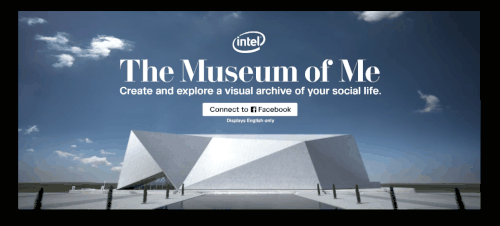 |
| Museum of Me shines with creativity. |
The campaign's content is merely a repurposing of updates, photos and videos from a participant's Facebook presence. However, the idea of displaying this content in a unique, museum style online environment is brilliant.
The audience reaction was swift and effusive with nearly one million hits within five days from launch. Plus, the creativity and imagination of the campaign reflects well on Intel, positioning the company as a market leader with the ability to transform industries.
Sunday, October 2, 2011
Social Media and Sales Acceleration in the Public Sector
When it comes to the public sector there is seldom a quick hit in enterprise sales.
Prospective government customers are appropriately demanding. They assess corporate capabilities and reputation. They evaluate product features and service offerings. They judge track record and contract performance.
A vendor that attempts to rush this evaluation process can sour the deal and, in some instances, soil the long-term relationship. That's because connections with government buyers are cultivated over time.
In fact, it's quite common for the opportunity identification and capture process to be measured in years.
The payoff sure is sweet though. Revenue generated from a multi-year, enterprise deal with a government agency can run well into the millions of dollars. Plus, the lifetime value of the customer engagement is significant, as it provides a critical qualification that can lead to follow-on work and new opportunities.
At Strategic Communications Group (Strategic), the majority of our clients sell complex products and services to government agencies, at both the federal and state/local levels. As such, our social media marketing focus and engagement methodology has gravitated towards direct support of the three most important benchmarks for success in the sales process -- lead generation, cultivation of prospect relationships and deal capture.
Yes...it is possible for executive management and marketers to align social media with sales by following these four steps:
Step 1 Evaluate prospects in the pipeline and prioritize the hot ones. Work closely with the sales team to cull prospects based on their purchase authority, intimacy of the existing relationship and timeline to buy. We'll typically select 20 to 25 targets who we anticipate having a need in the next 18 months.
Step 2 Map and monitor. Outline each prospect's social media engagement and online participation. What social networks are they active in? Do they blog? Who do they follow? Who follows them?
Monitor and update this social media map at least twice monthly to stay tuned in to how the prospect's network of connections evolves.
Step 3 Engage in a prospect's communities of choice. Connect socially with each target in LinkedIn, Govloop, GovWin, Twitter and the other online networks where they already spend time. Follow the conversations they participate in and stay tuned in to their updates.
Then, identify opportunities to bring value to the online discussion by sharing relevant content. This could include posts from your corporate blog, links to trade articles or research, and technical white papers and presentations. Steer clear of a blatant sales pitch by focusing on thought leadership and best practices.
Step 4 Evaluate, evaluate, evaluate. Set tactical benchmarks such as the number of prospect connections made in a social environment, online interactions and prospect visits to the corporate blog. Government buyers engage with those they trust, so this dialogue represents a deepening relationship.
Equally important, collaborate with the sales team on an ongoing basis to shape content for the blog and provide intelligence on how prospects interact with the company in an online environment. Seek anecdotal feedback from sales reps to understand how they have leveraged these social contacts to move deals forward more quickly.
--------------------------------------------------------------------------
This article will appear in an upcoming issue of an e-newsletter published by Market Connections, a provider of business-to-business and business-to-government market research services. Strategic Communications Group (Strategic) has partnered with Market Connections to survey the social media adoption of government agencies and public sector contractor community.
Wednesday, September 28, 2011
Inspiration from the Consumer Side
I live in a world of business-to-business and business-to-government marketers. Yet, I often find social media inspiration from effective consumer applications.
Here's an example. This article serves as a good reminder that content distributed via social networks is most effective when it engages, educates and entertains.
Relevance is established and community is constructed via a focus on thought leadership and best practices, rather than a sales pitch on a product, technology or service offering.
Friday, September 23, 2011
Perspective, Please
The headlines sure are depressing today. A stroll through the New York Times Web site reveals the following gems:
-Israeli/Palestinian turmoil
-Threats of a federal government shutdown due to a contentious Congress
-Continued anxiety about the European debt crisis
-A slowing Chinese economy which may (or may not) indicate that a new global recession is in play
-Growing concerns about new terrorist cells forming in Yemen
Of course, many in the marketing, digital and social circles are preoccupied with the calamity that is Facebook's change in functionality and user interface.
I realize we (me included) tend to not overly fret about events outside our control or influence. However, I wonder if all of this energy and ire directed at Facebook could be channeled towards more productive endeavors.

Wednesday, September 14, 2011
Why Innovation Thrives Throughout the Washington, DC Region
Geographies with thriving technology, software and telecommunications communities share a number of key attributes.
One such characteristic is the presence of a collection of market leading companies that serve as a breeding ground for executive talent. In the Washington, DC region, past innovators such as AOL and MCI once filled that role. They spawned a myriad of spin-outs and start-ups, which helped create an eco-system of innovation.
Today, government focused systems integrators such as Lockheed Martin, Northrop Grumman and Booz Allen Hamilton, as well as fast risers like Living Social, Merchant Link and Broadsoft provide the ideal environment for the cultivation of the next generation of business and technical leaders.
Additionally, centers of technology are populated with a capital community – from angel investors, venture funds and private equity firms to investment bankers who help entrepreneurs realize a successful financial exit.
Washington, DC scores high in access to funding. Consider the membership ranks of professional organizations like the Mid-Atlantic Venture Association (MAVA) and the Association for Corporate Growth (ACG). Executives with a bold idea, a credible business plan and a track record of execution typically find funding in town.
Finally, one vital – yet often overlooked – ingredient necessary for technology to take off in a region is the presence of high quality, research oriented universities. Think of the impact Stanford has in Silicon Valley or how MIT and Harvard define Boston.
Again, the Washington, DC region shows well when it comes to colleges that flood our business community with trained talent and viable ideas.
The University of Maryland, College Park is a prime example. While the business school and engineering program typically bask in the accolades, there are also less profile initiatives with a comparable level of benefit for the region.
For the past decade, the University of Maryland has fielded a team to compete in a global competition called the Solar Decathlon. Pulling students from multiple areas of study, including architecture, business, medicine, engineering and journalism, Maryland’s solar decathletes are charged with the design and construction of a house that meets the most stringent levels of environmental sustainability.
With funding provided by the US Department of Energy, as well as a handful of corporate sponsors, Maryland’s team will unveil its eco-friendly house this month for formal judging. The competition includes collegiate teams from the across the United States, plus countries like Canada, Belgium and New Zealand.
Win or lose, many of the 30 plus students who comprise the university’s Solar Decathlon team will enter the Washington, DC’s region work force primed to a contribute in a meaningful way.
And we’re all the better off because of it.
Tuesday, September 6, 2011
The Steroid Effect of Collaborative Content Development
Great news…you have a content rich, thought leadership fueled social media marketing program in place. Yet, readership and audience engagement has become stagnant and, like many organizations, you’ve struggled to raise the impact of the campaign.
At Strategic Communications Group (Strategic), we’ve repeatedly stepped into this dilemma in the execution of client programs during the past four years. Audience interest tends to grow in a series of steps, rather than the always desirable (yet rarely achieved) hockeystick model.
An approach we now employ to juice up the readership ranks, as well as the frequency and intensity of their engagement is collaborative content development with customers, partners, market influencers and other industry thought leaders. In addition to how it swells readership, this collaborative approach to content also instills third party credibility on a social site.
Here is a recent example: Strategic clients British Telecom (BT) and Polycom come together to produce and jointly promote a Web-based video on the environmentally-friendly impact of video teleconferencing:
To get the most from your investment in collaborative content, consider the following best practices:
1. Not all customers, partners and third-parties are equal. You’ll want to select those with a strong brand and reputation, as well an extensive social following.
2. Always…and I mean always…remember that social-distributed content must engage, educate and entertain. Regurgitated marketing slop or overly promotional gunk will rarely garner much in the way of interest.
3. Promote the content through multiple channels (i.e. social media, Email marketing, events, sales team distribution, etc.) to reach the broadest number of targeted readers, while tying everything to a defined organic search engine optimization (SEO) strategy.
4. Study your analytics each and every day. Readership and audience engagement provides near real-time feedback from the market in how your messaging has resonated.
Who is visiting your site? How do they find you? How long do they stay? Do they share the content with anyone?
This knowledge will inform your content strategy moving forward, as well as empower the sales team with insight and intelligence that can help them more effectively close deals…and faster.
Wednesday, August 31, 2011
Creativity, Unexpected
My introductory sales pitch to a prospective client touches on the corporate attributes that define Strategic Communications Group (Strategic). I like to keep things to a set of three which, in this case, include:
--Focus on a core set of client relationships;
--Commitment to work/life balance for employees; and
--Passionate pursuit of creativity in the development of social media marketing programs.
I had an interesting response last week from the director of communications at a mid-tier, publicly traded company in the Washington, DC area. It went something like this:
“Creativity in communications can mean lots of different things in marketing. Ask an ad agency and they’ll tell you its work that profiles and differentiates the brand. A PR firm will say it’s an approach that produces a feature article. A Web shop may say it is the use of hip new widget. What does creativity mean to you?”
I fumbled the response a bit and, admittedly, over answered the question. It’s not that I don’t know. It was more of an issue that I had never been asked that question directly.
So, after a few days of contemplation I went back to the communications director with a simple thought – in social media, creativity is presenting the expected in an unexpected way.
Here are two examples:
Wednesday, August 24, 2011
Finding the Supportive Path
I’m fortunate to have such positive and productive relationships with my colleagues at Strategic Communications Group (Strategic).
Yet, I am not a friend or a cheerleader. I don’t spew inspirational quotes. And there is no gold star at the end of the day for a job well done.
That’s because I respect each of my colleagues professionally. My job is to create an environment in which they are each set up for success, and be clear and consistent about expectations for performance.
It is then up to each individual to define and deliver on their own career path. For the truly talented, this empowerment is motivation enough.
However, it is absolute requirement for me to be publicly supportive and stand behind each of my colleagues in client interactions. Any disagreement I may have is shared in private for their consideration.
I raise this last point because of an article I recently read about a talk given by former Washington, DC school chancellor Michelle Rhee. Lamenting the failure of the US educational system to adequately prepare children for a globally competitive world, Rhee placed much of the blame on parents who tell their kids they are great when they aren’t.
“My two girls play soccer, yet they suck at soccer,” Rhee said, as her young daughters sat mortified in the audience.
Referring to the trophies and medals they’ve received for participation, Rhee continued, “We are so concerned with making children feel good about themselves. But, we haven’t put in the time to make them good at anything. We’ve managed to build a sense of complacency with our children.”
While I actually agree with Rhee’s contention about the harm done by this “everyone is a winner mentality”, I do take issue with the humiliation she chose to dump on her own daughters.
What possible purpose could that serve? Will it make them tougher? Inspire them to succeed?
Probably not.
The challenge in management is to find the path that allows you to be supportive, yet still set realistic expectations related to performance and professional growth.
Friday, August 12, 2011
Say "No" to Spray and Pray
The "spray and pray" methodology that has long defined media relations has gained a following in the world of social media marketing. I've included below an Email that slipped its way through Strategic Communications Group's (Strategic) spam filter.
I'm an ardent believer in the importance of promoting content created for distribution via social channels. Yet, it has to be thought-leadership oriented (rather than promotional) and, equally important, relevant to the members of a targeted community.
Yes...that takes work, as well as an understanding of the needs of key audiences.
Apparently, Lee Somerstein doesn't like to put in much effort on behalf of his clients. I don't smoke cigars or use any tobacco products, so I'm obviously not a member of any relevant online communities.
To me, this is spam.
----------------------------------
Hi,
Subscribe to:
Posts (Atom)


